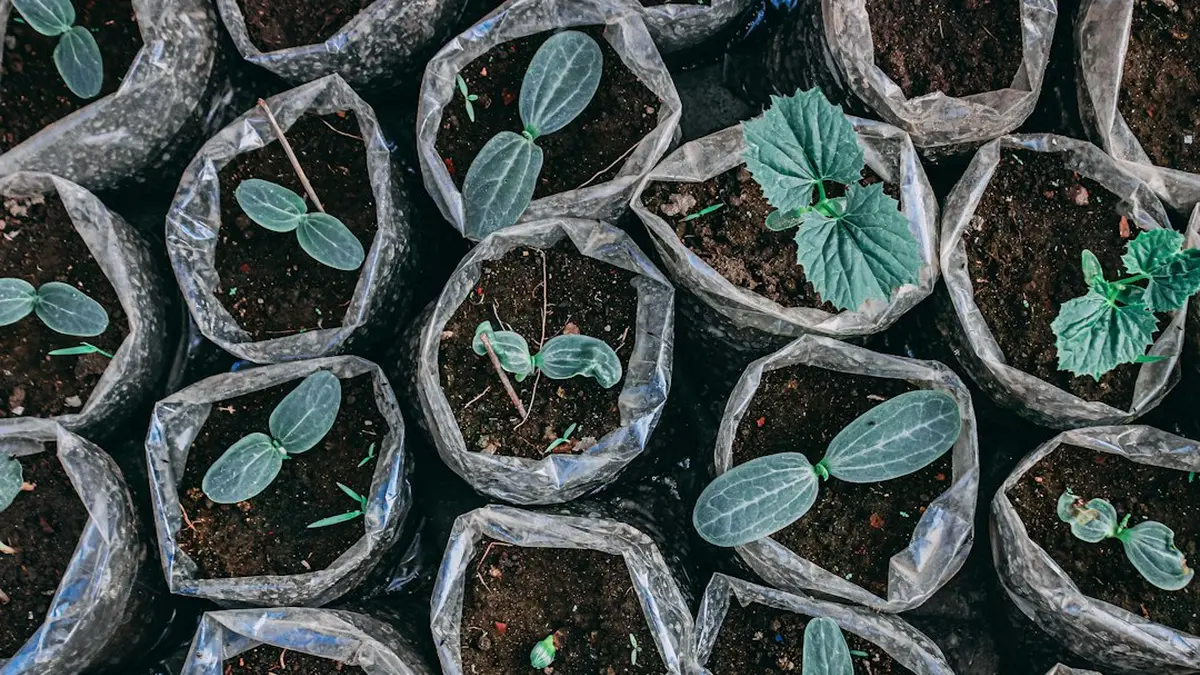
For most vegetables, a plastic pot is the easier container and a fabric grow bag grows the better root system. What decides it is water. Fabric dries out fastest, so bags suit gardeners who can water every day in summer. Plastic suits thirsty crops, tall staked plants and anyone who can water only once a day.
Terracotta sits between the two on drying speed. None of the sources below names a vegetable that grows better in clay than in either of the other two, so buy it for looks, not for yield.
How fabric and plastic compare on paper
| Feature | Fabric grow bag | Plastic pot |
|---|---|---|
| Material | Mostly polypropylene fabric, not biodegradable (Food Gardening Network) | Food-grade #2 HDPE, #4 LDPE or #5 PP recommended; avoid #3 PVC (UMD Extension) |
| Where excess water leaves | Through the whole fabric wall; "hard to overwater" (Rutgers Extension) | Through drainage holes (UMD, Illinois Extension) |
| Drying speed | Faster than plastic, glazed ceramic and terracotta (Illinois Extension, Food Gardening Network) | Slower than clay, ceramic and fabric (UMD, Illinois Extension) |
| Hot-weather watering | Daily (Garden Myths); choose fabric only if you can water 1 to 2 times a day (Bootstrap Farmer) | Choose plastic if limited to once a day (Bootstrap Farmer) |
| Roots at the wall | Air-pruned into a denser, fibrous system (UMD Extension) | Can circle; "far from severe" after one season (Garden Myths) |
| Root-zone heat | Evaporation cools the mix (Bootstrap Farmer, Food Gardening Network); only minor differences measured (Garden Myths) | Dark colors can overheat the mix and injure roots (UMD Extension) |
| Lifespan | 2 to 4 seasons (Garden Myths); 3 to 5 (Bootstrap Farmer); 4 to 5 (Food Gardening Network) | Decades (Garden Myths); a decade or more (Bootstrap Farmer) |
| Off-season storage | Folds flat (Rutgers Extension) | Rigid, does not fold |
| Upfront cost | Lower than plastic (Bootstrap Farmer) | Higher than fabric (Bootstrap Farmer) |
On Amazon, the choice usually comes as brand names: VIVOSUN multi-packs, Smart Pots and Root Pouch on the fabric side, and a Bloem Saturn planter on the plastic side. The extension and independent sources this piece draws on do not publish measurements or prices for those specific products. They compare the materials. So the table compares materials, and brand-by-brand figures on fabric weight, stitching or price per gallon are not something the published evidence here can settle. Within a category, the material behavior below is the part that holds.
Fabric grow bags
The University of Maryland Extension calls fabric grow bags "relatively inexpensive, reusable, lightweight, portable." Its case for them rests on air pruning. When a root tip reaches the porous wall, it meets dry air and stops. The plant then branches into many fine roots instead of wrapping around the inside of the pot.
Rutgers Cooperative Extension adds two practical points. It is hard to overwater a bag, because the fabric lets excess water out. Using fresh soil each season also lowers the risk of soil-borne disease. The same article says plainly that bag soil dries out quickly and needs more frequent feeding than a bed. It recommends at least a 5-gallon bag per full-size plant.
The counterpoint comes from horticulturist Robert Pavlis at Garden Myths. He estimates that fabric pots lose 30 to 56 percent of their usable soil. The outer inch or two dries too much for roots to grow into it. That figure is his estimate, not a replicated trial. Still, the practical advice holds either way: buy one size bigger than the minimum.
Buy fabric if you can water daily in summer and want pots that disappear into a shelf in winter.
- Air pruning gives a denser, more fibrous root system (UMD, Rutgers)
- Hard to overwater (Rutgers)
- Folds flat for storage (Rutgers, Food Gardening Network)
- Lower upfront cost than plastic (Bootstrap Farmer)
- Dries fastest of the common containers, often needing daily watering (Garden Myths, Illinois Extension)
- Needs more frequent fertilizing (Rutgers)
- Lasts 2 to 5 seasons depending on the source
- Loses heat quickly on cold shoulder-season nights (Food Gardening Network)
Plastic pots
Plastic's advantage is simple. It holds water longer than any porous material, and a good pot lasts for decades. Pavlis concludes that for vegetables and annuals, "plastic works better because it requires less watering." He also reports that circling roots in his own one-season trial were far from severe. That matters, because annual vegetables are gone before circling does much harm.
UMD adds two cautions. Stick to food-grade plastics, #2, #4 or #5, and avoid #3 PVC. Dark colors can also heat the potting mix enough to injure tender roots, so a lighter pot is the safer buy for full sun. Plastic not rated for UV can turn brittle and crack outdoors over time.
The weak spot is stability. Ken Johnson of Illinois Extension notes that plastic pots are light and prone to tipping with top-heavy plants. Square pots are the most stable shape and tapered round ones the least.
Buy plastic if you water once a day at most, or grow crops that wilt the moment they dry out.
Where terracotta fits
Clay is porous, so it dries faster than plastic. UMD and Illinois Extension both say so. The Food Gardening Network places it behind fabric, which dries faster still. It has a solid wall, though, so it does not air-prune roots the way fabric does.
That leaves terracotta with no advantage for vegetables in the published sources. It gets the watering burden of a porous pot without fabric's root benefit. It is a sensible choice for small herb plantings, which UMD sizes at just 1 to 3 gallons. It is not the container to reach for with a tomato.
Three things that separate them
Watering frequency, above everything. Every source agrees that fabric dries fastest. Bootstrap Farmer's rule of thumb is the most usable one: fabric if you can water once or twice a day in summer, plastic if you can manage only once.
This is not an abstract worry. NOAA's summary of summer 2026 found it was the warmest meteorological summer in the 132-year record. It also found high evaporative demand, meaning heat, sun, wind and dry air pulling water out of soil, in almost every state. Those are exactly the conditions that punish a bag.
How much the root benefit is worth. Air pruning is real, and UMD and Rutgers both endorse it. The size of the benefit is contested. Bootstrap Farmer, a supplier, claims up to 200 percent more fibrous root tips in fabric. Pavlis cites research on four tree species that grew identically in fabric and plastic. Settling it for vegetables would take a yield trial of the same crop in both containers, and none of these sources reports one.
Cost over time. Bags are cheaper upfront but last roughly 2 to 5 seasons. Plastic lasts a decade or more. If you plan to garden in containers for years, plastic pays back its higher price. If you want to try containers for a season or two, bags risk less money.
Which container to buy for which crop
Potatoes: fabric. UMD puts potatoes at about 30 gallons of growing media. A rigid pot that size is a permanent fixture. A bag that size folds flat after harvest, and Rutgers notes that bags make crop rotation easy.
Peppers: fabric, if you water daily. Peppers are among the crops Illinois Extension lists as well suited to grow bags. UMD's minimum is 5 gallons, and Illinois asks for a pot more than 16 inches across.
Hot climates with daily watering: fabric. Evaporation through the fabric may keep roots cooler than in black plastic. Pavlis measured only small differences, so treat that as a modest bonus rather than a reason on its own.
Staked tomatoes and thirsty crops: plastic, in a light color and a square or wide shape. The sources disagree on tomato size. Illinois says 3 gallons, UMD says 5 at minimum and 8 to 10 for large plants, and Illinois wants a pot more than 20 inches across. Go large, which also helps a tall plant resist tipping. Illinois Extension suggests 2 to 4 foot stakes or wire cages. Whether you need that support at all depends on growth habit, which is covered under staking needs and container suitability.
Herbs: whatever you like looking at. At 1 to 3 gallons, terracotta's drying rate is easy to manage.
Whichever you choose, two rules from UMD apply to every container. Make sure there are drainage holes. Do not put gravel in the bottom, because it raises the water level inside the pot and makes drainage worse. If your container collection starts growing past a dozen bags, the Food Gardening Network points out that large bags can stand in for a permanent raised bed, and at that point it is worth pricing the real thing.
The bags and pots named here
- VIVOSUN 5-gallon fabric grow bags, 5-packFive 5-gallon fabric bags: peppers, bush tomatoes, potatoes in pairs.
- Smart Pots 10-gallon fabric potOne 10-gallon fabric pot: a big indeterminate tomato or a potato tower.
- EarthBox Original self-watering garden kitA rigid self-watering box, if daily watering is the problem.
Fill them with the right amount: the potting soil calculator does the sum.
As an Amazon Associate Farmer's Delight earns from qualifying purchases. It costs you nothing extra and does not change what we recommend.
Comments
No comments yet. Be the first to comment!
Leave a Comment