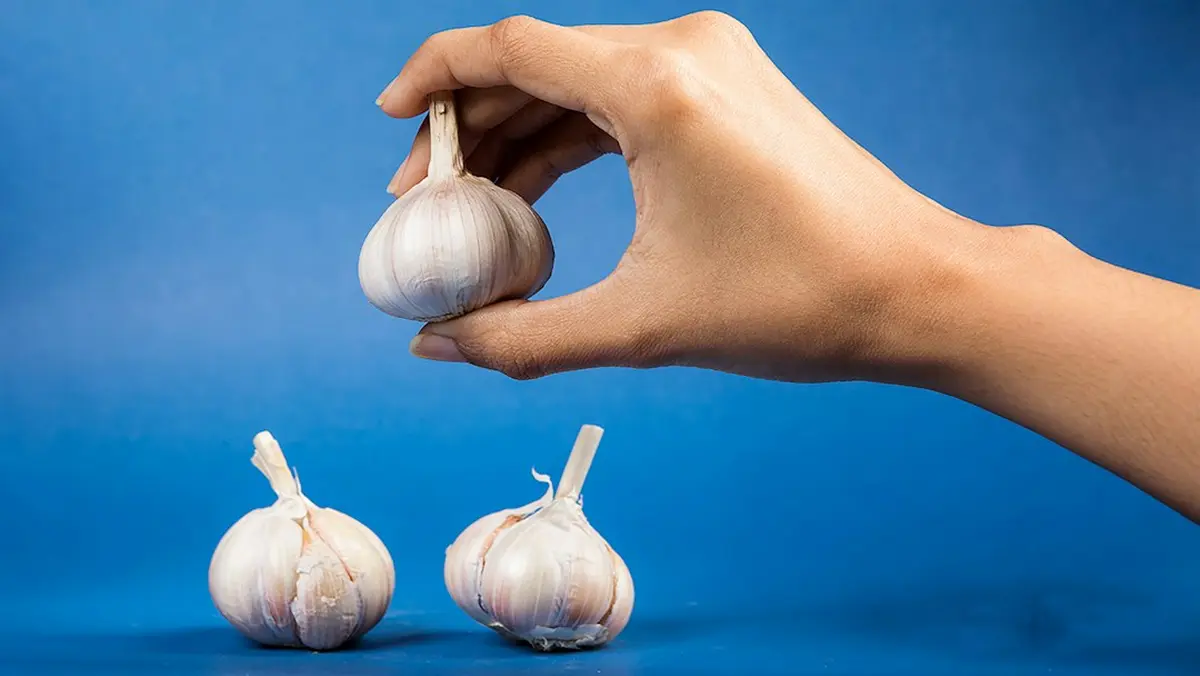
Garlic is the one crop you plant in autumn and harvest the following July, and the window for most of the country opens in the weeks around the equinox on September 22. This page takes you from an empty patch of dirt to a mulched, planted garlic bed, and tells you what to do with it between now and spring.
One warning shapes everything below: nearly half the country is in drought right now, so the watering advice that works in a normal year will drown or starve your cloves this one.
Garlic is planted in the cold on purpose
A garlic clove will not turn into a head of garlic unless it spends serious time cold. That process is called vernalization: a sustained stretch of chilling that tells the clove to divide into a bulb of many cloves rather than just fattening into a single lump. Growing guides put the requirement at roughly 4 to 8 weeks below 40°F, with hardneck types, the stiff-stemmed varieties that send up a flower stalk, needing it most.
That single fact explains the whole calendar. You plant in fall so the clove gets its winter for free, and Ohio State Extension notes that fall-planted garlic produces larger bulbs than spring-planted garlic for exactly this reason.
The second half of the idea is timing within the fall. You want the clove to put down roots before the ground freezes, and you do not want a tall green shoot standing up in December to be burned off. Penn State Extension's rule is to plant about three weeks before the ground freezes so roots develop without shoots poking through.
A good three weeks prior to the ground freezing, so the roots have a chance to develop, but not poke through the surface before winter.
When does your window open this fall?
The extension services answer this with conditions, not dates, and their answers agree with one another. South Dakota State Extension says garlic goes in one to three weeks after the first killing frost, when soil temperature is around 50°F. Oregon State Extension gives the whole season as September through November. Penn State counts back three weeks from ground freeze.
If you own a soil thermometer, use it. Push it two inches down in the afternoon and look for a reading in the 50s. Above about 65°F, the clove is likelier to put its energy into leaves instead of roots; too far below 40°F and roots will not establish at all.
If you do not own one, the zone calendars below will get you close. These come from grower blogs rather than universities, and they are estimates built on average frost dates, so treat them as a starting point and let your own frost and soil readings override them.
| USDA zone | Typical fall window | Second source |
|---|---|---|
| Zones 3 to 4 | Mid-September to early October | September (zones 0 to 4) |
| Zone 5 | October 10 to 31 | October (zones 5 to 7) |
| Zone 6 | October 20 to November 15 | October (zones 5 to 7) |
| Zone 7 | October 25 to November 30 | October (zones 5 to 7) |
| Zones 8 to 9 | November 15 to December 31 | October or November |
| Zones 10 to 11 | Not listed | December or January |
Windows in the left column are from Garden Truth, the right from Epic Gardening. Where they disagree, as they do in zones 8 and 9, the disagreement is real and unsettled in the sources: soil temperature at two inches is the tiebreaker.
Zone matters for variety too, not just date. Softneck garlic, the braidable kind sold in most supermarkets, depends less on vernalization, which is why growers in warm southern zones are pointed toward it. In frost-free zones 10 and 11, hardneck garlic will not get enough natural cold at all, and the workaround is to chill cloves in the refrigerator for five to ten weeks before planting.
What you need, and what you do not
This is a short list. Garlic is not a demanding crop at planting time; it is a patient one.
-
Seed garlic from a reputable dealer
Penn State Extension is specific about this: large, sound cloves from a seed-garlic dealer, not grocery store garlic. One pound of seed garlic plants a lot more bed than beginners expect, because you plant individual cloves, not whole heads. None of the extension sources quote a price, and it will vary by variety and supplier.
-
A spot with at least eight hours of direct sun
SDSU Extension sets the minimum at eight hours a day. Shade is the one site problem you cannot fix with amendments.
-
Soil that drains, worked eight inches deep
Loamy and well-drained, per Penn State. If water stands on the spot after rain, pick another spot or build up. A raised bed solves this faster than amending ever will.
-
Compost
Both Penn State and SDSU call for compost worked in before planting. Do this before the cloves go in, not after.
-
Straw or shredded leaves, enough for three to six inches over the bed
Shredded fall leaves are free and work as well as bought straw. Figure on more volume than looks reasonable; the layer settles.
-
A trowel, a hose or watering can, and something to weight the mulch
Penn State recommends securing mulch with branches or other weights in windy locations, which is most of the Plains.
-
Optional: a soil thermometer
The cheapest way to stop guessing at timing. You are looking for 50 to 60°F at a two-inch depth.
What you do not need: fertilizer at planting (Oregon State's schedule puts feeding in early spring and again in early May), a tiller, or any variety more exotic than what your regional seed supplier sells. If the bed itself is the missing piece, the five easiest vegetables for a first raised bed run through the same soil-mix and spacing decisions you are about to make here.
Planting the bed, step by step
Set aside an afternoon. A bed of forty or fifty cloves goes faster than you think once the soil is prepared.
1. Check the bed's history. Penn State recommends at least two years between garlic crops in the same ground, because soil-borne diseases build up. If garlic or onions grew there last year, move. You have done this right when you can name what grew in that spot the last two seasons.
2. Loosen the soil eight inches deep and work in compost. SDSU calls for rich, well-drained soil cultivated to at least eight inches with compost added. You should be able to push a trowel in to the handle without leaning on it.
3. Break the heads into cloves on planting day. Separate only what you will plant now. Use the largest, firmest cloves; set aside anything soft, moldy or bruised for the kitchen. Bigger cloves make bigger bulbs, which is the whole reason Penn State says to select large, sound cloves.
4. Plant each clove two inches deep, flat end down. The flat, slightly rough disc at the bottom is the basal plate, where roots come out. It faces down; the pointed tip faces up. Ohio State gives the depth as two inches, Penn State as at least two inches. When it is right, the tip sits below the surface and nothing is showing.
5. Space the cloves four to six inches apart, with rows 18 to 24 inches apart. Ohio State's numbers are four to five inches in the row; Penn State allows four to eight. In a small raised bed, a grid at five inches in both directions works and gives up nothing in bulb size. Wider is fine. Tighter is not.
6. Firm the soil and water the bed in once, thoroughly. Minnesota Extension's instruction for fall bulbs is to plant in well-drained soil and water them like your perennials. You want the top six inches uniformly damp, not a puddle. The surface should darken and then drain within minutes.
7. Mulch three to six inches deep with straw or shredded leaves. SDSU gives the range as three to six inches; Penn State suggests about four. Weight it down with branches if you get wind. You are done when you cannot see bare soil anywhere on the bed.
8. Label the row. In March you will not remember which end is the hardneck.
That is the crop planted. Between now and spring, the bed asks almost nothing of you.
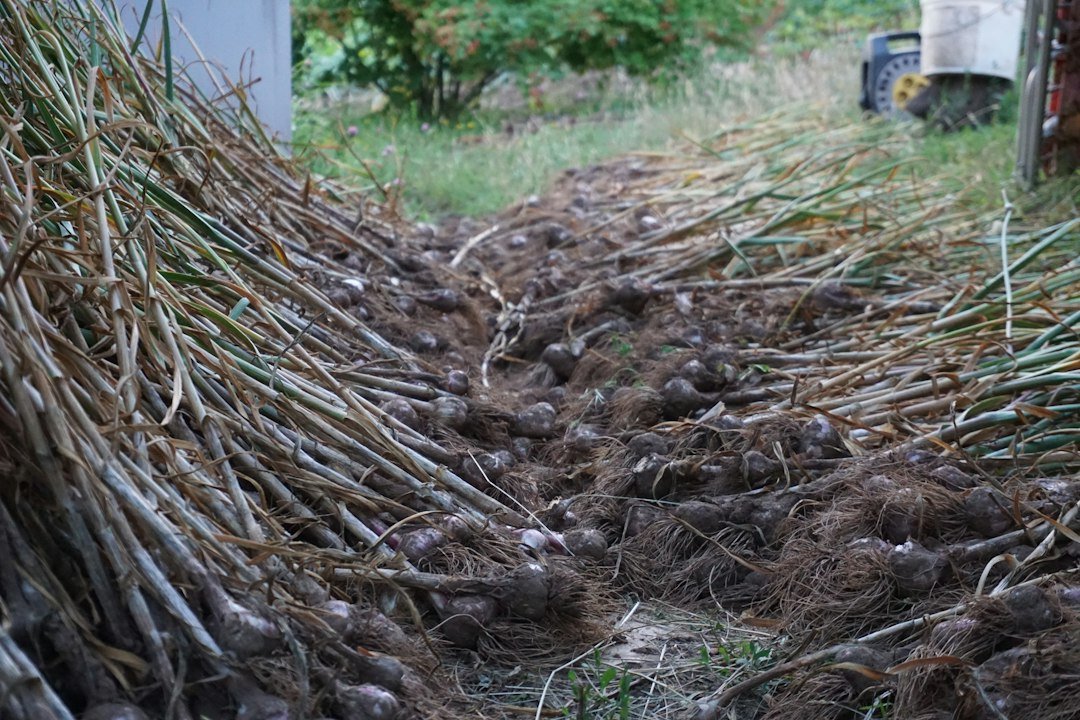
Photo by Dmytro Glazunov on Unsplash
How much to water in a year like this one
Here is the rule beginners get backwards: garlic needs one good soaking at planting, and after that it needs moisture checked rather than water added. Fall and winter rain usually does the job. Oregon State's guidance is that under normal conditions irrigation is not necessary at all, and only if soils are very sandy or spring turns dry does watering come into it.
The complication is that this is not a normal year across much of the country.
The national drought picture is also lopsided, which matters more than the headline number. In the Drought Monitor's map dated September 15, 2026, more than four inches of rain fell on central Iowa and southeastern Kansas while flash drought developed across Texas and the Ark-La-Tex on a combination of excessive heat and almost no rain. In the South region, nearly all locations deteriorated except parts of northern Arkansas. Northern Illinois and Indiana picked up new abnormally dry designations even as the Midwest around them improved.
NOAA's Climate Prediction Center expects drought to persist or worsen through the end of the year in the Northern Great Lakes and Plains, the Central Rockies and Great Basin, and the Southern Plains and Lower Mississippi Valley. It expects widespread improvement or removal across most of the rest of the continental U.S., including the Northeast on anticipated heavy late-September rain. The next update is due October 15, which is before the zone 6 and 7 planting windows close.
So what do you actually do with a hose?
Use your hand, not a schedule. Minnesota Extension's drought instruction is to get your hands in the soil and water if the top six inches are dry. Pull back a corner of the mulch, dig down, and feel. Damp at six inches means do nothing.
If it is dry down there and rain is not coming, water deeply and infrequently rather than lightly and often. The benchmark for garlic in active growth is about an inch of water per week, and Oregon State's dry-spell method is to water to a depth of two feet every eight to ten days. Shallow daily sprinkling is the failure mode: it keeps the surface wet, which does nothing for roots two inches down and everything for rot.
Mulch is the other half of the answer. Minnesota Extension lists mulching with raked leaves as a drought tactic specifically because it holds soil moisture, so the three to six inches you put down at planting is doing irrigation work all winter. If you are deciding what else goes into an empty bed this fall, the case for fall cover crops under drought conditions runs on the same soil-moisture math.
Four ways a first garlic bed goes wrong
Planting supermarket garlic. Penn State is blunt about selecting cloves from reputable seed-garlic dealers rather than grocery store garlic. The problem is that you cannot tell whether it was a mistake until June, when an unknown variety that may have been grown for a completely different climate gives you small bulbs or none. There is no fix in season. If you have already planted grocery cloves, leave them in, treat the bed as an experiment, and order seed garlic for next fall.
Planting too early. Warm soil sends the clove into leaf growth instead of root growth; one grower guide puts the threshold around 65°F at two inches. You will know because six inches of green foliage appears in October and then freezes. The plant usually survives, but it has spent energy it wanted for spring. Add mulch, leave it alone, and plant two weeks later next year.
Too shallow, or upside down. Cloves planted at an inch, or with the pointed end down, show up as gaps in the spring row and as cloves heaved to the surface after a freeze-thaw cycle. If you find heaved cloves in late winter, push them back down and re-cover with mulch. Two inches deep with the basal plate down prevents it.
Watering on a calendar through fall and winter. This is the most common overcorrection in a drought year, and the damage arrives late. Ohio State warns that excessive water as bulbs form causes rot, and its instruction is that when the leaves begin to yellow, reduce irrigation because the plant needs to dry down. Soggy soil that never dries between waterings, and bulbs that come out of the ground soft or with slipping wrappers, are the signs. Check moisture at six inches and water only when it is dry.
What happens between now and July
Nothing until spring. The bed sits under mulch; the cloves root; you do not lift the mulch to look.
When growth starts, four things are on the schedule. Oregon State's program is fertilizer in early spring and again in early May. Around May or early June, hardneck plants push up a curling flower stalk called a scape, and removing it sends the plant's energy back into the bulb. Through June, aim for the roughly one inch of water per week that both SDSU and Ohio State use as the baseline, more in hot dry wind, less in cool spring weather. Then reverse: as leaves yellow, taper off, and stop watering about two weeks before harvest so the wrappers cure properly. Oregon State puts harvest in mid-July in its climate.
Keep the mulch in place until temperatures are reliably warm, then use it for weed suppression rather than pulling it.
The next thing worth learning is how the rest of your ground behaves in cold weather, because garlic beds sit through the whole winter and not all parts of a yard freeze alike. Working out where frost pockets and warm walls sit in your own garden is what creating and using microclimates is for, and it changes where you put next October's row.
Comments
No comments yet. Be the first to comment!
Leave a Comment