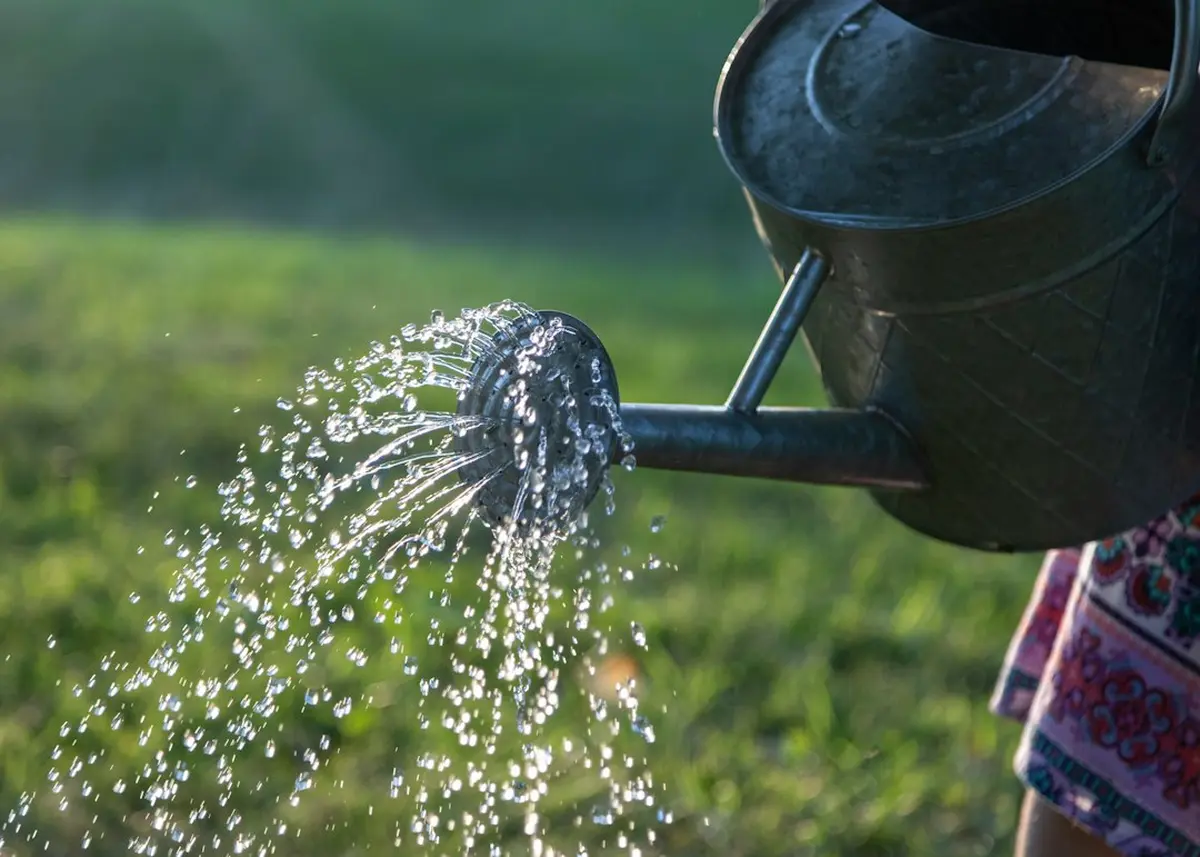
How often should you water vegetables in pots? Check every container once a day. Water any pot whose top inch of mix is dry, and keep pouring until water runs out of the drainage holes. In summer heat that usually means daily for most pots, and twice a day for some.
The check takes under a minute per pot. The one thing to know first is that there is no fixed schedule. Potting mix dries far faster than garden soil because the roots have so little of it, so the pot tells you when it needs water, not the calendar.
What you need
-
Pots with drainage holes
Penn State Extension calls drainage holes non-negotiable. Without them, roots sit in water and rot.
-
A watering can or a hose with a water breaker
A water breaker is a nozzle that softens the stream so it doesn't blast mix out of the pot.
-
Mulch for the top of each pot
Straw, shredded leaves or similar, to slow evaporation from the surface.
-
Pot feet or bricks, if your pots sit in saucers
Raising the pot lets it drain freely.
The daily check, step by step
-
Push a finger into the mix to the first knuckle
That is about an inch. UF/IFAS Extension says to water when the top half inch to one inch feels dry. It worked if you can say plainly whether it's dry or damp. Damp means skip this pot today. For light pots, lifting works too: a dry pot feels noticeably lighter.
-
Aim the water at the base of the plant
Wet leaves spread disease, so keep the spout under the foliage. It worked if the leaves stay dry.
-
Keep pouring until water drips from the bottom
University of Maryland Extension notes that several shallow waterings are not nearly as effective as one long one. It worked if water drips freely from the drainage holes.
-
Empty the saucer
Standing water keeps the bottom of the mix soaked, and UMD calls overwatering a leading cause of container failure. It worked if the pot is no longer sitting in water.
-
Do it in the morning
UF/IFAS recommends morning watering because less is lost to evaporation and leaves dry quickly. Check your local rules too. Under Stage 1 drought restrictions as of October 1, 2026, Arvada, Colorado allows hand or drip watering of vegetable gardens on any day, but not between 10 a.m. and 6 p.m.
-
Mulch the surface once
Virginia Cooperative Extension says mulching container soil reduces evaporation. It worked if the mix under the mulch stays damp longer between checks.
How often that check ends in watering depends on heat, wind, pot size and pot material. Small pots dry faster than large ones. Plastic and metal hold moisture longer than unglazed terra cotta or wood, which lose water through their sides. The extension sources don't mention fabric grow bags. But fabric is porous too, so expect bags to dry like terra cotta rather than like plastic.
| Conditions | How often to check and water | Source |
|---|---|---|
| Hot summer, most pots | At least once a day | Penn State, UMD Extension |
| Hot, dry or windy days | Check twice a day | Virginia Cooperative Extension |
| Above 90°F, small pots | May need water twice daily | SeedlingSage (a gardening blog, not an extension service) |
| Cool fall weather | No published figure; let the finger test decide | UMD says need rises with heat and plant size, so expect it to drop |
Two fall cautions. Pots near a wall or under eaves may get no rain at all, UMD warns, so check them even in wet weeks. And rain is unreliable this year: Drought.gov reported 49.78% of the U.S. and Puerto Rico in drought as of September 29, 2026.
If it did not work
Do a meter, drip kit or self-watering pot help?
A soil moisture meter such as the XLUX Soil Moisture Meter does the same job as your finger. None of the sources here publish specs or independent results for it, so its accuracy can't be judged from them. The finger test costs nothing and is what extension services recommend.
If you're away often, Virginia Cooperative Extension recommends an automatic drip emitter system.
A self-watering container holds a water reservoir under the mix. According to UMD, a 5-gallon bucket version in full sun in July and August still needs 1 to 2 quarts of water a day. Its advantage is slack: you can ignore it for a few days without the plant drying out.
You can now tell any pot's needs in a few seconds a day. If one pot is always dry by afternoon, it is probably too small for its plant.
Is the pot big enough for what's in it?
A chart of common vegetables with the minimum container volume and soil depth each one needs.
See the container size chart
Comments
No comments yet. Be the first to comment!
Leave a Comment